


A judge has urged legal parties in the Drumcree march dispute to “step back from the abyss” and “reach agreement for the sake of everyone in Northern Ireland”.
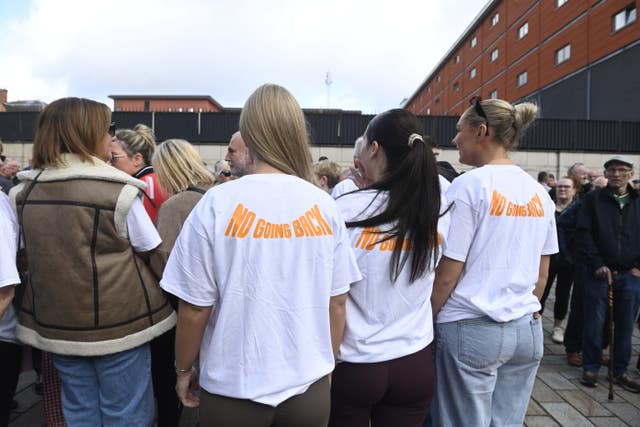
Lawyers are engaged in a High Court proceeding as residents of the predominantly nationalist Garvaghy Road have launched a legal challenge against a ruling to permit the Orange Order to walk down the street for the first time in 30 years.
The Parades Commission, which decides on contentious marches in Northern Ireland, ruled on the order’s application for the Drumcree event, allowing them to walk there.
The commission placed a number of restrictions on the procession, including an 8am start time on Sunday and limiting it to 35 participants.
The PSNI is expected to put in place a significant security operation for the parade, with officers from outside the region set to assist under mutual aid arrangements.
On Saturday, barrister Denise Kiley KC representing Garvaghy Road residents said they had been given the PSNI’s written assessment in relation to the proposed march on Sunday and an earlier procession due to take place on July 5 that did not go ahead.
She said the issue is significant because the Parades Commission concluded in their ruling they “had no information that there is potential for disorder”.
Ms Kiley said that ruling “is something that is directed to future risk but what we have in the police assessment are entirely directed to past risk”.
She said the PSNI said there had been “no disorder associated with the return parade” in recent years.
“Nowhere there do we see any assessment of future risk,” she said, questioning the evidential basis for the decision given that “the determination that is under challenge squarely makes a finding about future risk”.
“On the face of it for the reason that I’ve given, it is not in fact an answer so it rather begs further questions,” she said.
She added: “That all leads to a requirement for more time and for the Parades Commission to explain the discrepancy that is apparent on the face of the documents”
Ms Kiley said previous PSNI assessments given to the commission were also relevant given the fact “this is a departure from an established position”.
High Court judge Justice Patricia Smyth said some of the issues brought up by the residents may lead to temporary leave being granted.
“To make an informed decision about the lawfulness of the Parade Commission decision, there is further information and potentially evidence that would assist me,” she said.
She highlighted that the information provided to the court from the PSNI has “prompted further inquiries” and “further time would be of benefit to the court”.
The judge said the issue they are dealing with is of “fundamental importance”.
“It is right to say that much has improved between the two communities in the area but it is fragile,” she said.
“In my view it would be contrary to justice and unwise to proceed to make a decision in the absence of information in relation to the issues I have identified,” she said.
Ms Smyth added that the important date for the Orange Order is July 5 and therefore “there is no prejudice in adjourning for a short period to allow this case to be prepared by all parties”.
“Indeed, I think it is to the disadvantage of the Orange Order and the Parades Commission for the parade to proceed,” she said.
The judge concluded: “I urge parties again to reach agreement for the sake of everyone in Northern Ireland,” encouraging them to “be big enough to step back from the abyss”.
Earlier, Tony McGleenan KC, representing the Parades Commission outlined the options available to the court.
He said there would be “no prospect” of the Parades Commission reconsidering, stating they would not have time to reconsider the decision at this stage, flagging that an application had been made for a 5,000-attendee protest against the march on the Garvaghy Road at 7am.
Mr McGleenan said if the court quashes the determination by the Parades Commission then the march would lawfully be able to proceed without restriction, as those are imposed as part of that body’s ruling.
A third option available to the judge is an injunctive release – making an order preventing the procession going ahead.
“Given the time pressure we’re under we should get to that point,” he said.
Mr McGleenan also warned against the “courts being drawn into a merits review of decision making”.
“I can see the ready temptation for an applicant to say to the judge at two o’clock to say, we need more information to understand the merits of the decision,” he said.
Peter Coll KC representing the PSNI, said the terms threat assessment or risk assessment is not phraseology used by police to describe their submissions to the Parades Commission.
Referring to the request for all police submissions in relation to the more than 1,000 Drumcree Parade applications over 28 years he expressed “some scepticism as to how practical that might be”.
On return to court Ms Smyth said the parties had not been able to reach agreement.
Ms Kiley outlined potential next steps for the court to take, but reiterated the concern of Mr McGleenan that if the commission decision was simply quashed it would allow the march to go ahead without restrictions, because the Orange Order had “duly notified” the parade.
She then suggested the judge could suspend the parades decision, and the effect of the Orange Orders notification.
John Larkin KC, representing Alan Hynes, said he was not able to speak for the Orange lodge as a whole, but suggesting requesting such a move was asking the court to “rewrite a historical event”.
“I can’t think of a single incident at any time in any of our courts when a judge has been asked to essentially rewrite history,” he said.
Ms Kiley said she was not asking the court to “rewrite reality”, but added: “I don’t resign from Mr Larkin’s suggestion that it’s novel but we’re trying to be creative.”
As the court rose for the fifth time, Ms Smyth said: “My view that the issues at stake are so sensitive and so important that I would expect all of the lawyers to be creative and to use the law for the good of the people of Northern Ireland.”


Share